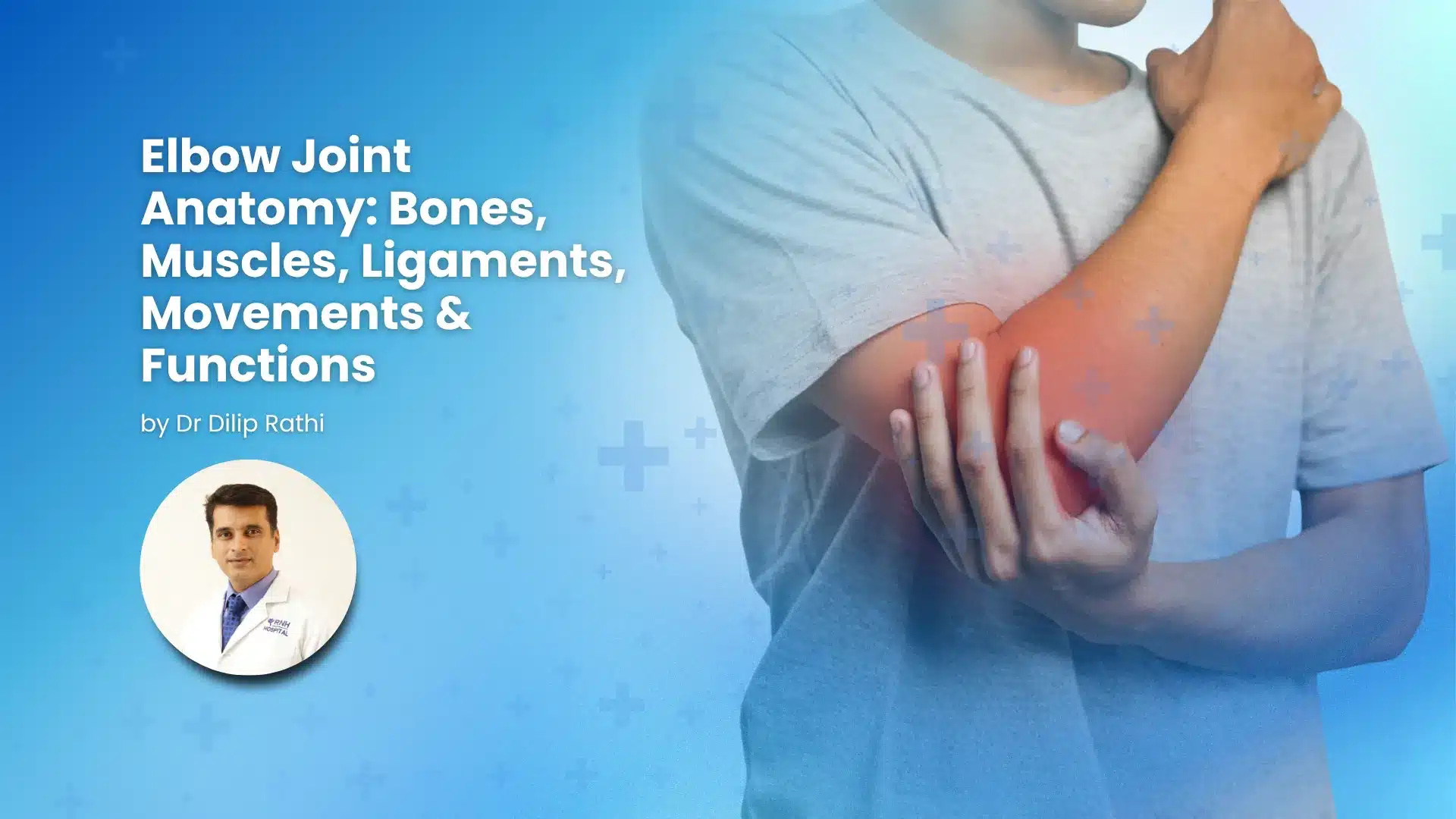
Elbow Joint Anatomy: Bones, Muscles, Ligaments, Movements & Functions
The elbow is an important joint that connects the upper arm to the forearm. It allows the arm to bend and straighten while also contributing to the rotation of the forearm, helping you perform everyday activities such as eating, writing, lifting, reaching and exercising.
The elbow joint is formed by three bones — the humerus, radius and ulna — and is supported by cartilage, ligaments, muscles, nerves and blood vessels. Its combination of stability and mobility makes it an important part of normal arm function.
In this guide, we explain elbow joint anatomy, elbow bones, muscles, ligaments, movements and functions, along with common elbow problems and when medical evaluation may be needed.
What Is the Elbow?
The elbow is the joint where the upper arm bone (humerus) meets the two bones of the forearm — the radius and ulna.
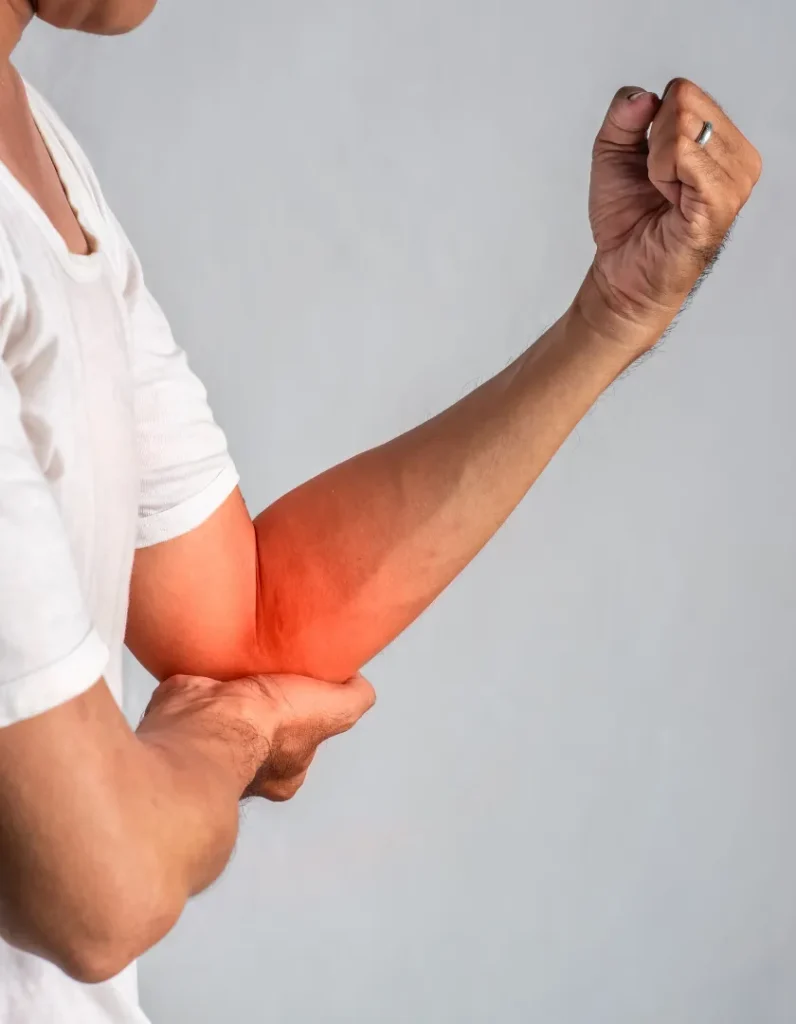
It allows the forearm to move relative to the upper arm and works together with the shoulder and wrist to provide functional movement of the entire upper limb.
The elbow is a synovial joint. Its main joint complex includes the ulnohumeral, radiocapitellar and proximal radioulnar articulations, which work together to provide flexion, extension, pronation and supination.
What Type of Joint Is the Elbow?
The elbow is commonly described as a hinge joint because its main movement involves bending and straightening the arm.
It also works with the proximal radioulnar joint to allow forearm rotation. This enables movements such as turning the palm upward and downward.
The major movements include:
- Flexion: bending the elbow
- Extension: straightening the elbow
- Supination: rotating the forearm so the palm faces upward
- Pronation: rotating the forearm so the palm faces downward
These movements allow the hand to be positioned for many daily activities.
Elbow Joint Anatomy
Understanding the elbow joint anatomy becomes easier when it is divided into its major components:
- Bones
- Cartilage
- Ligaments
- Muscles and tendons
- Nerves
- Blood vessels
- Joint capsule and surrounding structures
The three bones form the foundation of the elbow, while the soft tissues provide stability, movement and protection.
What Bones Make Up the Elbow Joint?
There are three main bones associated with the elbow joint:
1. Humerus
The humerus is the long bone of the upper arm. Its lower end forms important parts of the elbow joint, including the trochlea and capitellum, which interact with the ulna and radius.
2. Radius
The radius is one of the two forearm bones. Its upper end, called the radial head, articulates with the capitellum of the humerus and participates in forearm rotation.
3. Ulna
The ulna is the other major forearm bone. Its proximal end includes the olecranon and coronoid process, which contribute significantly to the elbow’s stability and movement.
Quick overview
| Bone | Location | Main role |
| Humerus | Upper arm | Forms the upper part of the elbow |
| Radius | Forearm | Helps with elbow movement and forearm rotation |
| Ulna | Forearm | Forms a major part of the hinge mechanism |
Elbow Joint Ligaments
Ligaments are strong bands of connective tissue that connect bones and help stabilize a joint.
The elbow contains important medial and lateral ligament complexes as well as the annular ligament.
Ulnar Collateral Ligament
The ulnar collateral ligament (UCL), also called the medial collateral ligament complex, is located on the inner side of the elbow and contributes to medial stability.
Lateral Collateral Ligament Complex
The lateral side of the elbow contains several stabilizing structures, including the radial collateral ligament and lateral ulnar collateral ligament.
Annular Ligament
The annular ligament surrounds the radial head and helps stabilize the proximal radioulnar joint while allowing the radius to rotate during pronation and supination.
Together, these ligamentous structures help maintain elbow stability while allowing controlled movement.
Muscles Around the Elbow Joint
Several muscles of the upper arm and forearm contribute to elbow movement.
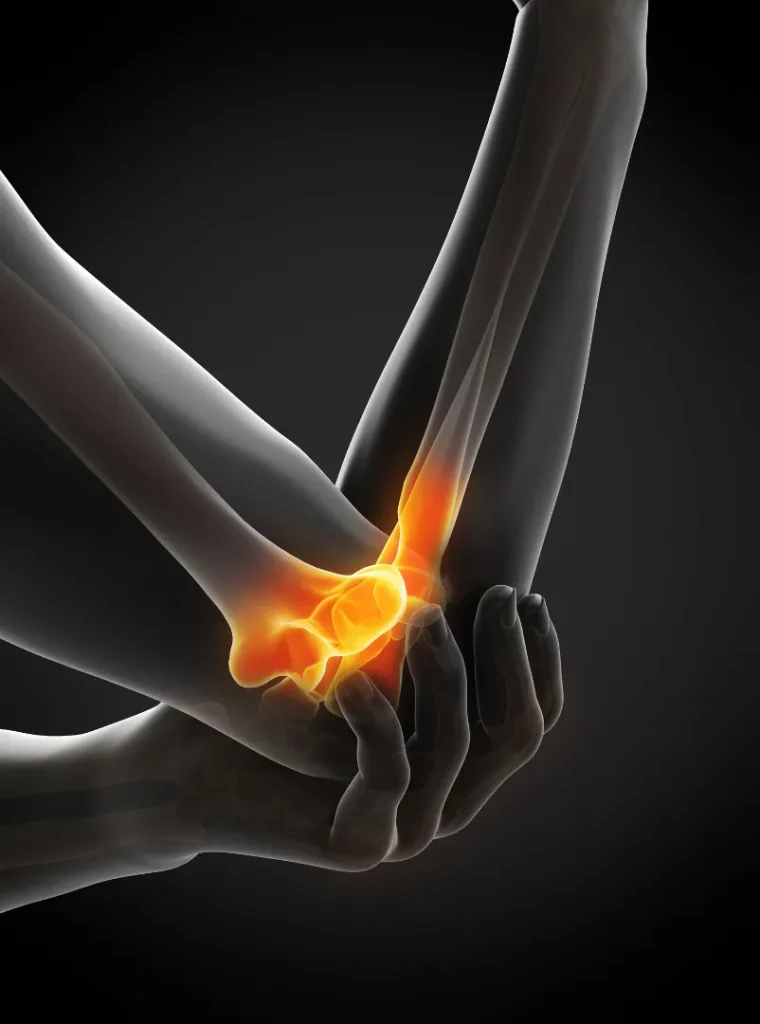
Muscles involved in bending the elbow
Important elbow flexors include:
- Biceps brachii
- Brachialis
- Brachioradialis
Muscles involved in straightening the elbow
The primary extensor is:
- Triceps brachii
The anconeus also contributes to elbow extension.
Other muscles contribute to pronation and supination of the forearm.
Because many muscles cross or attach around the elbow, overuse or injury involving muscles and their tendons can cause pain and reduced function.
Elbow Joint Movements
The elbow and associated forearm joints allow several important movements.
Flexion
Flexion occurs when you bend your elbow, bringing the forearm closer to the upper arm.
Examples include:
- Bringing food toward your mouth
- Lifting an object
- Bending your arm during exercise
Extension
Extension occurs when you straighten your elbow.
Examples include:
- Reaching for an object
- Pushing something away
- Straightening the arm during exercise
Supination
Supination rotates the forearm so that the palm faces upward.
Pronation
Pronation rotates the forearm so that the palm faces downward.
These movements are produced through coordinated activity of the elbow and proximal radioulnar joint.
What Is the Function of the Elbow?
The elbow plays an important role in positioning the hand and controlling arm movement.
It helps you:
- Bend and straighten your arm
- Reach for objects
- Lift and carry objects
- Push and pull
- Position your hand for writing and eating
- Rotate the forearm
- Perform sports and exercise movements
The elbow therefore provides a combination of mobility and stability that is essential for everyday activities.
Common Elbow Problems and Injuries
Problems affecting the elbow can involve bones, cartilage, ligaments, muscles, tendons, nerves or other surrounding tissues.
Some commonly encountered conditions include:
Tennis Elbow
Tennis elbow, or lateral epicondylitis, involves pain around the outer part of the elbow and is commonly associated with repetitive loading of the forearm muscles and tendons.
Golfer’s Elbow
Golfer’s elbow, or medial epicondylitis, affects structures around the inner side of the elbow and can be associated with repetitive forearm activity.
Elbow Fracture
A fall, direct impact or other injury can cause fractures involving the bones around the elbow.
Elbow Dislocation
An elbow dislocation occurs when the joint surfaces are forced out of their normal alignment and requires prompt medical assessment.
Elbow Arthritis
Arthritis can affect the joint and may cause pain, stiffness and restricted movement.
Ligament or Tendon Injuries
Injuries to the elbow’s stabilizing ligaments or surrounding tendons can result from sports, repetitive activity or trauma.
What Causes Elbow Pain?
Elbow pain can have many possible causes. It may occur after an injury, repetitive activity, sports, overuse or as a result of an underlying joint or soft-tissue condition.
Symptoms may include:
- Pain while bending or straightening the elbow
- Swelling
- Stiffness
- Reduced range of motion
- Tenderness
- Weakness
- Instability
- Pain during lifting or gripping
The cause cannot always be determined from symptoms alone. A healthcare professional may need to examine the elbow and, when appropriate, use imaging or other investigations.
When Should You See an Orthopedic Doctor for Elbow Pain?
Consider seeking medical evaluation if elbow pain:
- Continues or repeatedly returns
- Makes normal arm movement difficult
- Is associated with significant swelling
- Occurs after a fall or direct injury
- Causes weakness or instability
- Limits sports, work or daily activities
- Is accompanied by persistent stiffness or restricted movement
Following an injury, severe pain, obvious deformity, loss of normal movement or symptoms suggesting nerve or blood-vessel involvement warrant prompt medical assessment.
How Is an Elbow Problem Diagnosed?
An orthopedic evaluation generally begins with a discussion of your symptoms and medical history followed by a physical examination.
Depending on the suspected condition, a doctor may recommend investigations such as:
- X-ray
- Ultrasound
- MRI
- CT scan
- Other appropriate tests
The appropriate investigation depends on the suspected injury or condition.
Treatment also varies according to the cause and severity. It may include activity modification, medication when appropriate, physiotherapy, injections or surgery in selected cases.
Elbow Joint FAQs
What is the elbow?
The elbow is the joint connecting the upper arm’s humerus with the forearm’s radius and ulna.
What type of joint is the elbow?
The elbow is a synovial joint that functions primarily as a hinge for flexion and extension, while the proximal radioulnar component enables forearm rotation.
What bones are in the elbow?
The three main bones are the humerus, radius and ulna.
What are the main elbow ligaments?
Important stabilizing structures include the ulnar collateral ligament, lateral collateral ligament complex and annular ligament.
What muscles move the elbow?
Major muscles contributing to elbow movement include the biceps, brachialis, brachioradialis, triceps and anconeus, along with muscles involved in forearm rotation.
What movements does the elbow allow?
The main movements associated with the elbow complex are flexion, extension, pronation and supination.
Why does my elbow hurt?
Elbow pain can result from several causes, including overuse, tendon problems, arthritis, fractures, dislocations and ligament injuries. A medical evaluation can help determine the underlying cause.
Can elbow problems be treated without surgery?
Some elbow conditions can improve with nonsurgical treatment, depending on the underlying diagnosis. Treatment should be based on the specific condition rather than on elbow pain alone.
Takeaway
The elbow joint is a complex structure made up of the humerus, radius and ulna, supported by cartilage, ligaments, muscles and other soft tissues. Its coordinated movements allow us to bend and straighten the arm and rotate the forearm for everyday activities.
Understanding elbow anatomy, bones, muscles, ligaments and movements can help you better understand common elbow problems. However, persistent pain, significant injury or restricted movement should be evaluated by an appropriate healthcare professional.
Need Evaluation for Elbow Pain?
RNH Hospital, Nagpur provides orthopedic care for a range of bone, joint and musculoskeletal conditions. If you have persistent elbow pain, an injury or difficulty moving your arm, consult an orthopedic specialist for an appropriate evaluation.
Book an Orthopedic Consultation → https://rnhhospital.com/contact-us/